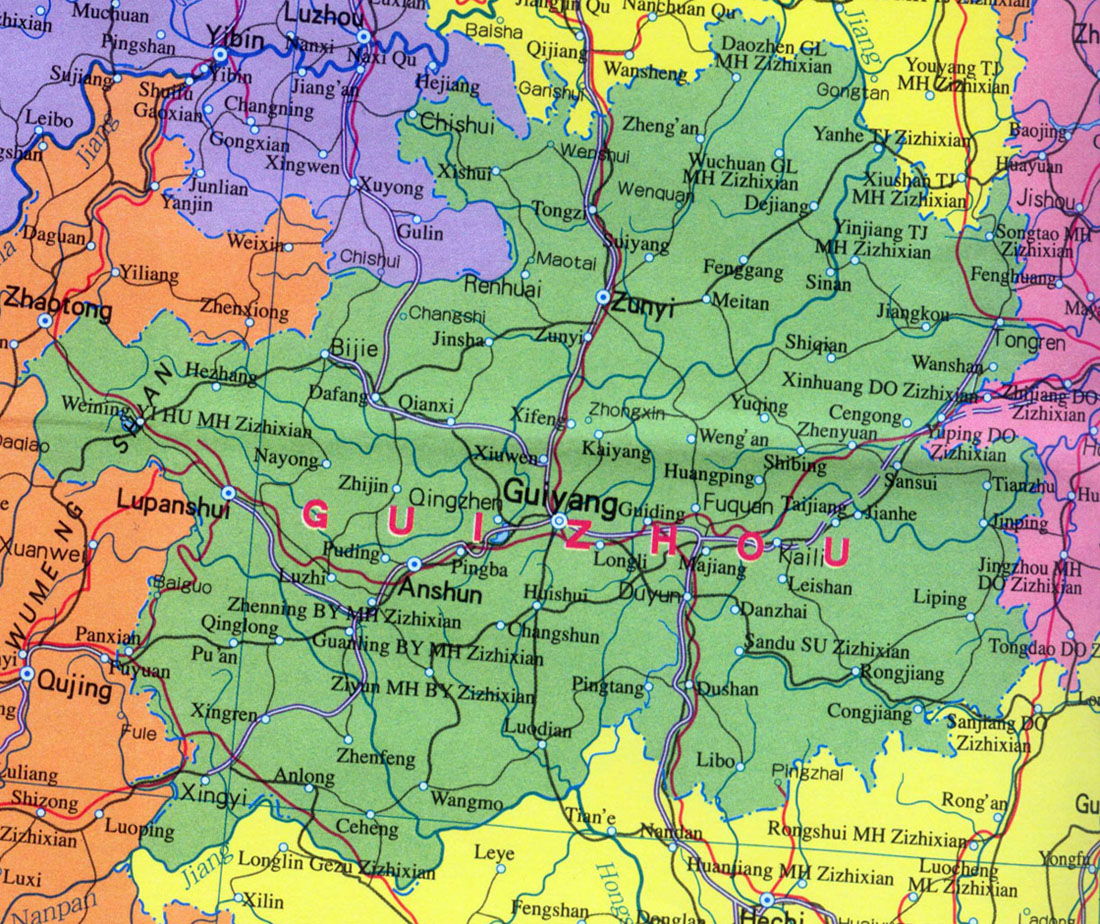
uploaded at: http://www.flickr.com/photos/98531730@N02/9443943468/in/set-72157634956626472/
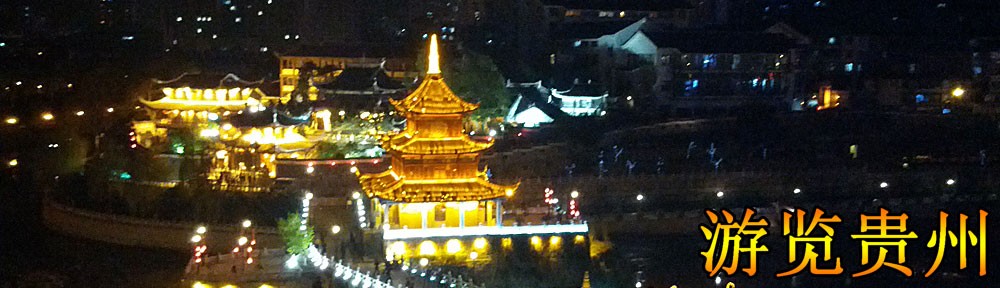
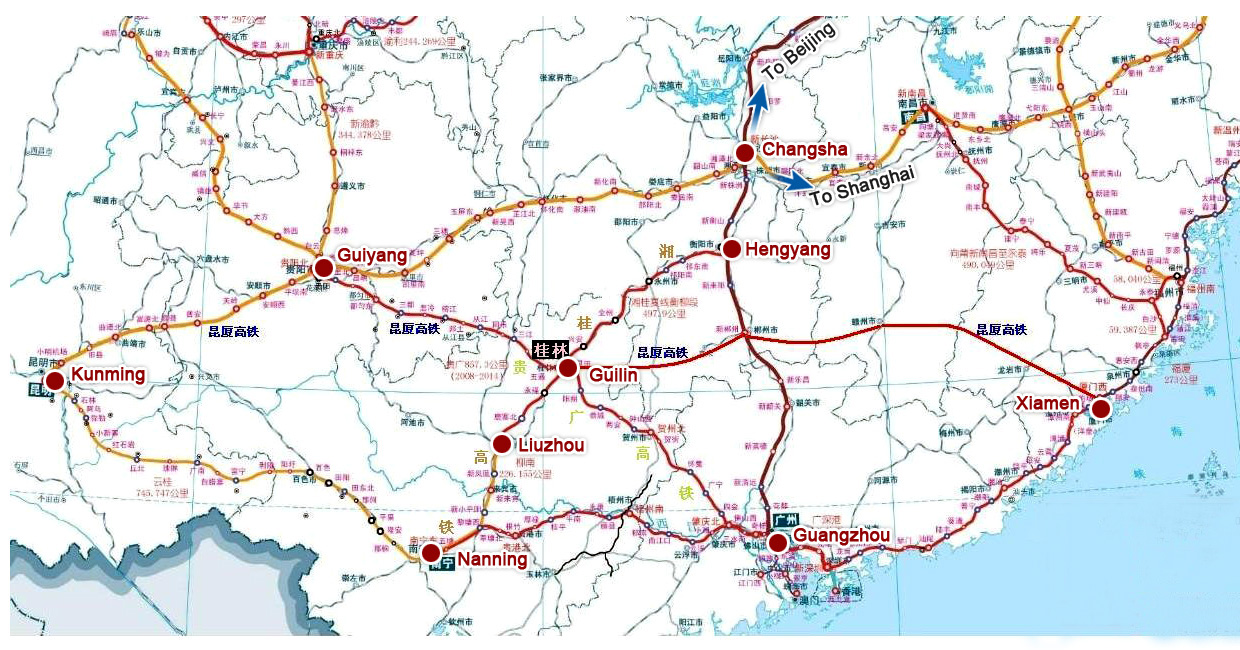
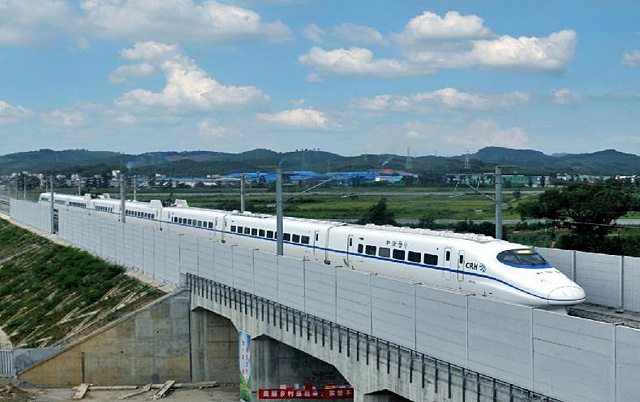


images from http://www.flickr.com/photos/98531730@N02/9516188476/in/set-72157634956626472/ , maps from http://baike.baidu.com/view/4766536.htm?fromId=2693963&redirected=seachword and http://baike.baidu.com/view/1961893.htm
Guiyang-Guangzhou high speed rail to open this December
2014-09-16 05:54:30 [english.cqnews.net/html/2014-09/16/content_31993802.htm]
The construction of the Guiyang-Guangzhou high speed rail has come to an end and its debugging is being carried out to make sure the line is put into operation by the end of the year, the Guiyang-Guangzhou high speed rail scheduling conference was told.
It is expected that the standard speed of the Guiyang-Guangzhou line will be 250 km/h. With a total length of 857 kilometers, the high speed rail will start from north Guiyang, stopping at Longli, Duyun, Danzhai, Rongjiang, Congjiang, Guilin, Gongcheng, Hezhou, Zhaoqing, Sanshui and Foshan, to arrive at its terminal Guangzhou.
There are 21 stops in total, and 8 stops among them are inside Guizhou province.
After completion, the duration from Guiyang to Guangzhou will be reduced to only 4 hours, from as long as 20 hours before.
Tunnels will carry more than 80 percent of the Guiyang-Guangzhou high speed railway. And for convenience, a 3G and 4G network will cover most of the tunnels.
Source: China Daily
= = =
Guiyang–Guangzhou High-Speed Railway – Wikipedia, the free encyclopedia [en.wikipedia.org/wiki/Guiyang%E2%80%93Guangzhou_High-Spee…]
Guiyang-Guangzhou High Speed Railway is a major trunk route selected in the 11th Five Year Plan by the Chinese government. It will allow a fast link between the South-West Chinese provinces of Sichuan,Chongqing, Guizhou and Guangxi to the economic power houses of China in Guangdong and Hong Kong. It will allow for a massive reduction travel time between Guiyang and Guangzhou from 22 to 4 hours.
The 857 km route of this railway is more direct than current routes. This is due to the exceptionally difficult and mountainous terrain, making this high-speed project very expensive to construct. Project cost is estimated at 85.8 billion RMB (USD$12.6 billion).[1] This means 209 tunnels are required over the length of this route, some being in excess of 14 km in length.[2] It will pass through the major tourist destinations of Guilin and Yangshuo in Guangxi province with its unique karst landscape.
Construction commenced in 2008 and is expected to take 6 years to complete.

map from http://www.tour-beijing.com/guizhou_tour/
Guizhou Festivals and Special Events
March – Miao Flower Festival
April – Dujuan Flower Festival
May – Anshun Batik Art Festival
June – Taijang Dragon Boat Festival
July – Bouyei Chabai Musical Festival
August – Tongren Miao Culture Festival
October – Zunyi Liquor Exposition
November – Kaili Lusheng Musical Festival
December – Caohai Bird-watching Day

Beijing- Guiyang – Kaili – Rongjiang – Zhaoxing – Sanjiang – Longsheng – Guilin – Shanghai
price: 2-5 persons: US$ 2604 per person
from http://www.topchinatravel.com/china-tours/14-days-southwest-experience-tour/
Tour Overview
| Day | Destination | Highlights |
| 01 | Arrival Beijing | Be transfer to hotel |
| 02 | Beijing | Tian’anmen Square, The Forbidden City, The Temple of Heaven |
| 03 | Beijing | Mutianyu Great Wall, Summer Palace |
| 04 | Beijing – Guiyang | Hutong Tour by rickshaw, Fly to Guiyang |
| 05 | Guiyang – Kaili | Coach to Kaili, Kaili Folk Museum, Matang Ge Village |
| 06 | Kaili- Rongjiang | Coach to Rongjiang, Langde Miao Village, Chejiang Drum Tower |
| 07 | Rongjiang – Zhaoxing | Basha Miao Village, Zhaoxing Dong Village, Coach to Zhaoxing |
| 08 | Zhaoxing – Sanjiang | Chengyang Wind and Rain Bridge, Sanjiang Drum Tower |
| 09 | Sanjiang – Longsheng | Coach to Longsheng, Longji Rice Terraces, Ping’an Zhuang Village |
| 10 | Longsheng – Guilin | Coach to Guilin, Be transferred to the hotel |
| 11 | Guilin – Yangshuo – Guilin | Li River Cruise, Coach to Guilin |
| 12 | Guilin – Shanghai | Flight to Shanghai, Be transferred to the hotel |
| 13 | Shanghai | Jade Buddha Temple, Yuyuan Garden, Oriental TV Tower, The Bund |
| 14 | Departure Shanghai | Be transferred to the airport |

click THIS for a larger, clearer version of the map: http://www.flickr.com/photos/98531730@N02/9508940538/sizes/o/in/set-72157634956626472/

from Wikipedia, http://en.wikipedia.org/wiki/Guanshanhu_District , image uploaded at: http://www.flickr.com/photos/98531730@N02/9527381711/in/set-72157634956626472/
Guanshanhu District (simplified Chinese: 观山湖区; traditional Chinese: 觀山湖區; pinyin: Guānshānhú Qū) formerly the Jinyang New Area (JYND; simplified Chinese: 金阳新区; traditional Chinese: 金陽新區; pinyin: Jīnyáng Xīnqū) is a district located northwest of the city centre of Guiyang, the capital of Guizhou Province, People’s Republic of China. The city centre itself is surrounded by mountains and lush forests Guanshanhu District is situated beyond the city’s mountains on high-plains interspersed with rolling hills at an average altitude of 1,400 metres (4,600 ft).[1]
As a new city district of Guiyang, the Guanshanhu District is focused on government, finance, real estate, high-tech, transportation, aerospace and commercial services. Since its inception in 2001, through the end of 2008, 43 billion yuan was invested in the Guanshanhu District. Since 2006 the Guanshanhu District has been home to Guiyang’s Municipal Government Administration and CCP Offices.
While the population of the Guanshanhu District more than doubled in the 5 years between 2004 and 2008 from 70,000 to 180,000, a combination of Guiyang’s attractive residency policy and the habitation of many of the district’s larger residential developments resulted in further large-scale growth by the end of 2012 as the district’s population reached an estimated +220,000 residents. Guanshanhu’s population is anticipated to continue to climb exponentially over the next 5 years as a majority of Guizhou provincial and Guiyang municipal government agencies, many major local employers as well as several large national and international corporations relocate to the district in concert with continual development and upgrading of the area’s transportation and logistics infrastructure, linking the district to the regional and national transportation grids.[2]
The Guanshanhu District has a well-developed road transportation network with a sophisticated grid of signalized multi-lane roadways capable of adequately addressing anticipated future heavy vehicular traffic flows as well as providing convenient access to the Guiyang–Zunyi Expressway, the Guiyang Outer Ring Road and Second Ring Road highways, and stations serving the national hi-speed rail and city light-rail networks currently under construction. The Gui-Zun Expressway, the Guiyang Outer Ring Road and Guiyang Second Ring Road highways pass through the district and are part of the national trunk highway system. These divided multi-lane motorways provide the district with rapid vehicular access to the city center, Guiyang Longdongbao International Airport, and all points within Guizhou including the cities of Zunyi, Anshun, and Kaili, as well as the large regional cities of Chongqing, Chengdu, Kunming, Guilin,Changsha, Nanning, and Guangzhou.
Guanshanhu District is home to the JinYang Regional Bus Terminal, the largest coach and bus terminal in Guizhou Province, servicing over 7 million passengers annually.
The national high-speed railway network will be accessible through Guiyang North Station, situated in the eastern area of the Guanshanhu District and currently under construction, with estimated opening in 2015. Guiyang North Station will connect Guiyang with Chengdu, Chongqing, Kunming, Guangzhou, Changsha,Wuhan, Shanghai, and Beijing via 100 daily CRH bullet trains. Guiyang is currently building a three-line urban light rails system with the city’s fline-1 of the system anticipated to be operational in 2015, connecting the Guanshanhu District to the older, established Guiyang central business district, several established high-density inner-city residential neighborhoods, and the airport.[3]