Guizhou transportation: section of Burma Road: 24-Zig 滇缅公路24拐 in Qinglong 贵州青龙;heroic construction of Guizhou-Guangxi railroad; “Southwestern Silk Road” in Yunnan

24-Zig along the Burma Road (滇缅公路24拐),  in Qinglong, southwest Guizhou prov.

“The “24-zig” is in Guizhou Province, it has 24 sharp bends on a high mountain. The Burma Road was largely built by Chinese during World War II to bring supplies to beleagured China, to help Chinese resist the Japanese invasion.
(from www.chinawhisper.com/top-10-most-dangerous-roads-in-china )
– – –
Historic ’24-zig’ Rediscovered on Stilwell Road

August 15, 2002, China Daily (?)

People can see a famous old photo on websites about World War II: convoys of US GMC military trucks snaking up a steep zigzag road in southwest China’s mountainous region.

It illustrates the crucial lifeline that linked the Chinese battlefield with allied forces 57 years ago. The road, nicknamed “24-zig” because it has 24 sharp bends on a high mountain, was believed to lie on the famous Stilwell Road, also known as the Burma Road.

Along the road, mountains of guns, bullets and food were carried by US trucks to China to fight against the Japanese troops.The “24-zig” was so geologically typical and a symbol of the times that its fame was soon spread worldwide by the international media.

However, after the war ended half a century ago, the precise location of the “24-zig” faded from memory. Many Chinese, Japanese and Westerners tried to pinpoint it along the Stilwell Road and the Burma Road in Yunnan Province, but it seemed to have disappeared off the face of the earth.

Guo Shuya, a Chinese expert in World War II history, has been studying the road for many years. In 2001, he happened to get a piece of information from Japan that the “24-zig” was not on the Stilwell Road as many experts believed, but actually on another road in nearby Guizhou Province.
Guo went to Guizhou and sought help from elderly drivers, and they told him the “24-zig” was in a county named Qinglong, two hundreds miles away from Guiyang, capital of Guizhou.

Guo made his way to Qinglong where he rediscovered the “24-zig”.

“I have solved a riddle that has puzzled people worldwide for half a century, ” he said. “It seems that we still don’t know verymuch about World War II.”

The Stilwell Road was a single road built in 1944 between Indiaand China’s Yunnan Province. However, the international community usually regarded all the traffic networks in southwest China as being part of the famous road, which was named after Joseph Stilwell, commander-in-chief of the China-Burma-India war theater.

“The ’24-zig’ is indeed in Guizhou, and it can be seen as an extension of the Stilwell Road,” said Zhou Mingzhong, an official with the Guizhou Transportation Bureau.

He said that the road was built by US troops and remained undamaged. These days curious drivers usually ride on the historic road for fun.

“Currently, Guizhou is investing heavily in a campaign to buildnew roads. However, we will preserve the “24-zig” according to itsoriginal look,” said Zhou, adding that “it is a relic of World War II, and a symbol of Sino-American friendship”.

Lin Kongxun, 80, a former interpreter with the US 1880 engineerbattalion stationed along the “24-zig”, said that the road was so dangerous many trucks overturned. “Whenever the US drivers got onto the road, they prayed to God,” said Lin, a professor from the Huanan Agriculture University.

But it was the terrible, unforgettable road that guaranteed final victory in the war against the Japanese, he asserted.

Guo’s rediscovery of “24-zig” has amazed the world. Guo and Lin believe that the road will serve as an emotional link between China and the United States in the 21st century.

“I hope people from different countries will return to the road to remember its history, just like the reunion of surviving Chinese and US pilots in Beijing in May this year,” Guo said.

Before the India-Burma-China road was constructed, all strategic materials had to be carried into China by air. A total of 468 US planes crashed when crossing the Himalayas, killing 1,579 pilots.

Lin said a reunion of veterans of the 1880 engineer battalion was held in 1986. “After the gathering, I received a lot of pictures and reports about the Stilwell Road mailed by my American friends,” he said.

= = =
The Burma Road.

for photos see: www.tinyadventurestours.com/Eng/Destinations/BurmaRoad.html

The road was constructed between 1937 and 1938 during the ‘Second Sino-Japanese War’ by combining existing roads and tracks and upgrading them for use by heavy transports and even building completely new roads and bridges. This all through an area in which till then hardly any roads had existed. The purpose of the road was to keep supplies coming in while the eastern sea ports of China were controlled or blocked by Japanese forces.
empty spacer
The road got closed off by the Japanese occupation of Burma and western Yunnan. Control over the road resulted in critical battles like the battle at the Huitong Bridge and the battle at Songshan Mountain in the Gaoligong mountain range.
During the second world war American engineer regiments constructed a new road from Ledo in India across Burma to connect to the original Burma Road. The combined road got named “Stilwell road” after American General ‘Vinegar Joe’ Stilwell.
Burma road at present. The present day enlarged and improved Burma Road crossing the Gaoligong mountain range near Longling.
At the turn of the century the British had attempted to extend their rail network from Lashio in Burma into Yunnan but had given up because the terrain was one of the hardest in the world with many mountains and big rivers to cross. The only east/west connection was the ‘Southern Silk Road’, a combination of footpaths and horse trails leading to footbridges and ferry crossings.
The Burma Road was constructed by an unskilled local labour force of thousands recruited from the various tribes living along the route. The tools used were local farming tools and complicated constructions were avoided by letting the road hug the higher parts of the mountains and avoiding the valleys with rivers and streams as well as muddy flat lands as much as possible.

Nowadays.

Over the years the road got widened and paved with cobble stones but the road in its full length does not exist anymore as such. National road G320 incorporated parts of the old road and some parts got abandoned. Now the new G56 four lane motorway replaces the G320 again. This modern, road with many bridges and tunnels, makes it possible to drive the entire length of the old Burma Road in hours.

uploaded at: http://www.flickr.com/photos/98531730@N02/9458002583/in/set-72157634952466595/

Transportation in Guizhou before trucks/cars and roads:

It used to take 18 days to go from Guiyang to Chongqing !

from “Kueichou – An Internal Chinese Colony,” by J E Spencer, Pacific Affairs, vol. 13,no 2,(Jun,1940), pp 162-172 quote from pp. 167

see whole article free with Google Books :  http://www.jstor.org/discover/10.2307/2751051?uid=3737800&uid=2&uid=4&sid=21102567805507

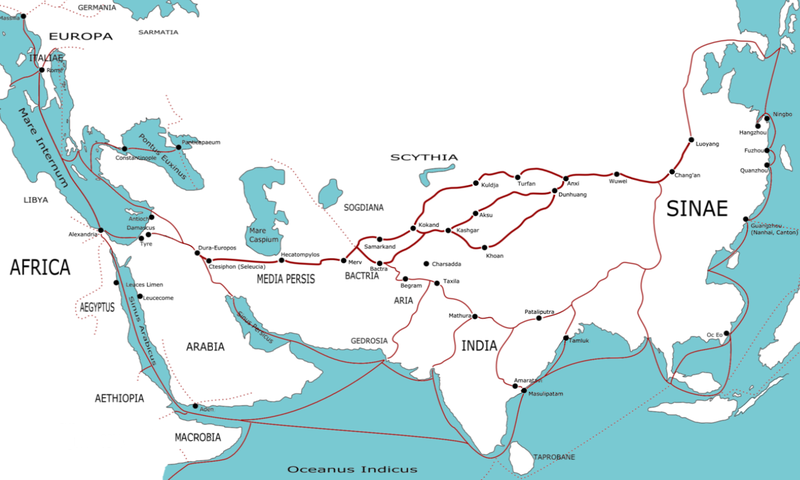
Trade routes in the Yuan dynasty. Note the “Southwestern Silk Road” passing through Yunnan (and a bit of Guizhou)

clicik here for full sized map: http://www.flickr.com/photos/98531730@N02/9479280594/sizes/l/in/set-72157634952466595/ , from  http://www.drben.net/ChinaReport/Sources/China_Maps/China_Empire_History/Map-EurAsian_Trade_Routes-1200-1300AD-1A.html

File:Transasia trade routes 1stC CE gr2.png

Trans Asia Trade Routes, 1st century AD from http://en.wikipedia.org/wiki/File:Transasia_trade_routes_1stC_CE_gr2.png

A famous Chinese archaeological writer Bin Yang, whose work, ‘Between Winds and Clouds; The Making of Yunnan’, published in 2004 by the Columbia Universitypress and some earlier writers and archaeologists, such as Janice Stargardt strongly suggest this route of international trade as SichuanYunnanBurmaBangladesh route. According to Bin Yang, especially from the 12th century the route was used to ship bullion from Yunnan (Gold and Silver being among the minerals in which Yunnan is rich), through northern Burma, into modern Bangladesh, making use of the ancient route, known as the ‘Ledo’ route. The emerging evidence of the ancient cities of Bangladesh, in particular Wari-Bateshwar ruinsMahasthangarhBhitagarhBikrampur, Egarasindhur and Sonargaonare believed to be the international trade centers in this route.[34][35][36]

(from http://en.wikipedia.org/wiki/Southern_Silk_Road )

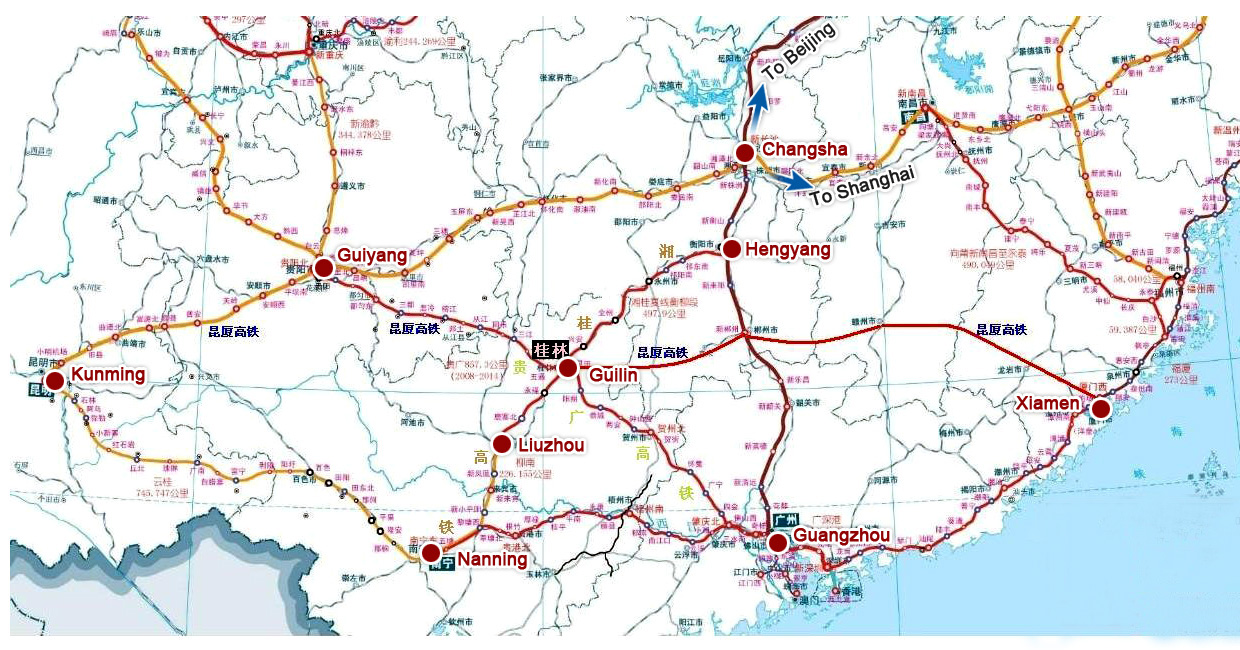
Guizhou-Guangxi railway  (Guiyang-Liuzhou railway; Qian-Gui railway 黔桂铁路)

photo: The Guizhou-Guangxi Railway near the Layi Station in Nandan County, Hechi, Guangxi.

The Guizhou-Guangxi Railway or Qiangui Railway (simplified Chinese: 黔桂铁路; traditional Chinese: 黔桂鐵路; pinyin: qiánguì tiělù), is a single-track electrified railroad in Southwest China between Guiyang in Guizhou Province and Liuzhou in Guangxi Zhuang Autonomous Region. The shorthand name for the line, Qiangui, is derived from the shorthand names of Guizhou (Qian 黔) and Guangxi (Gui 桂).
The railway was originally built from 1939 to 1958 and had a total length of 607 km (377 mi). From 2004 to 2009, the line was rebuilt to add tunnels and bridges in place of switchbacks over mountainous terrain and reduced in length to 489 km (304 mi). Travel time between the two terminal cities has been reduced from 14 hours to 5 hours.[1]
Major cities and towns along route include Liuzhou, Liujiang, Liucheng, Yizhou, Hechi, Dushan County, Duyun, Guiding County, Longli County, and Guiyang. The Qiangui Railway is a major rail conduit in western China from Baotou in Inner Mongolia to Gulf of Tonkin.

History

Construction of the Guizhou–Guangxi Railway began under the Republic of China during World War II to provide the country’s wartime capital, Chongqing, with an outlet to the sea.[2] In April 1939, with the Japanese invasion threatening Jiangxi and Hunan Provinces, the Chinese government chose to abandon construction of the Hunan–Guizhou Railway and shifted personnel southwestward to the Guizhou–Guangxi corridor.[2] From September 1939 to February 1941, 161 km (100 mi) of track was laid in the plains from Liuzhou to Jinchengjiang (Hechi).[2] The 237 km (147 mi) Jinchengjiang to Dushan section was completed by May 1943, and gave rail access to the airfield at Dushan.[2] Dushan served as a base for the Flying Tigers and reception point for the allied air shipments over “the hump” from India. The Qiangui Railway was used to redistribute supplies to southern Guizhou and Guangxi.[2] Pilots shot down and rescued in rural Guangxi and Guizhou were sent to stations along route and transported by rail back to Dushan.[2]

On the electrified and rebuilt section of the Qiangui Line between Yizhou and Hechi.
Over 200,000 workers were mobilized for the project in Guangxi and 30,000 in Guizhou.[2] Over 2,000 workers died of disease and accidents.[2] Work on the final section from Duyun to Guizhou was halted in 1944 with the Japanese Ichi-Go Offensive. In November 1944, the Japanese captured Liuzhou and proceeded to travel up the railway to attack southern Guizhou. The Chinese forces defending Mawei, Dushan and Duyun proceeded to destroy the railway and train cars. After the Japanese surrender in 1945, the Republican government began to repair the sections damaged by the war. The Chinese Civil War intervened and by 1949 only the Liuzhou-Jinchengjiang section had been restored.
After the founding of the People’s Republic of China in 1949, the new government removed rails from 300-km unrepaired section from Jinchengjiang to Qingtaipo to build the Hunan–Guangxi Railway.[1] Construction on the Jinchengjiang to Duyun section of the Guizhou–Guangxi Railway resumed in 1955 and was completed in 1958. The entire line officially opened on on January 7, 1959. Aside from the Guiyang to Guiding section which had double-track, the rest of the line was single track.
Due to the mountain terrain and steep inclines on the line, average travel speed on the line was limited to 41 km/h (25 mph) for passenger service and 21 km/h (13 mph) for freight.[1] From December 2004 to January 2009, the railway underwent reconstruction to expand capacity.[1] The Luoman (Liujiang) to Jinchengjiang section of the line was largely rebuilt.[1] Entirely new lines were built between Jinchenjiang to Longli and between Liuzhou and Luoman.[1] The Liuzhou to Longli section was electrified.[1] As a result, the length of the line was shortened by 118 km (73 mi).[1] Travel speed rose to 160 km/h (99 mph) between Liuzhou and Jinchengjiang and between and 140 km/h (87 mph) between Jinchengjiang and Longli.

(from Wikipedia, http://en.wikipedia.org/wiki/Guizhou%E2%80%93Guangxi_Railway)

Construction of the Guizhou–Guangxi Railway began under the Republic of China during World War II to provide the country’s wartime capital, Chongqing, with an outlet to the sea.[2] In April 1939, with the Japanese invasion threatening Jiangxi and Hunan Provinces, the Chinese government chose to abandon construction of the Hunan–Guizhou Railway and shifted personnel southwestward to the Guizhou–Guangxi corridor.[2] From September 1939 to February 1941, 161 km (100 mi) of track was laid in the plains from Liuzhou to Jinchengjiang (Hechi).[2] The 237 km (147 mi) Jinchengjiang to Dushan section was completed by May 1943, and gave rail access to the airfield at Dushan.[2] Dushan served as a base for the Flying Tigers and reception point for the allied air shipments over “the hump” from India. The Qiangui Railway was used to redistribute supplies to southern Guizhou and Guangxi.[2] Pilots shot down and rescued in rural Guangxi and Guizhou were sent to stations along route and transported by rail back to Dushan.[2]

photo:
On the electrified and rebuilt section of the Qiangui Line between Yizhou and Hechi.

Over 200,000 workers were mobilized for the project in Guangxi and 30,000 in Guizhou.[2] Over 2,000 workers died of disease and accidents.[2] Work on the final section from Duyun to Guizhou was halted in 1944 with the Japanese Ichi-Go Offensive. In November 1944, the Japanese captured Liuzhou and proceeded to travel up the railway to attack southern Guizhou. The Chinese forces defending Mawei, Dushan and Duyun proceeded to destroy the railway and train cars. After the Japanese surrender in 1945, the Republican government began to repair the sections damaged by the war. The Chinese Civil War intervened and by 1949 only the Liuzhou-Jinchengjiang section had been restored.
After the founding of the People’s Republic of China in 1949, the new government removed rails from 300-km unrepaired section from Jinchengjiang to Qingtaipo to build the Hunan–Guangxi Railway.[1] Construction on the Jinchengjiang to Duyun section of the Guizhou–Guangxi Railway resumed in 1955 and was completed in 1958. The entire line officially opened on on January 7, 1959. Aside from the Guiyang to Guiding section which had double-track, the rest of the line was single track.
Due to the mountain terrain and steep inclines on the line, average travel speed on the line was limited to 41 km/h (25 mph) for passenger service and 21 km/h (13 mph) for freight.[1] From December 2004 to January 2009, the railway underwent reconstruction to expand capacity.[1] The Luoman (Liujiang) to Jinchengjiang section of the line was largely rebuilt.[1] Entirely new lines were built between Jinchenjiang to Longli and between Liuzhou and Luoman.[1] The Liuzhou to Longli section was electrified.[1] As a result, the length of the line was shortened by 118 km (73 mi).[1] Travel speed rose to 160 km/h (99 mph) between Liuzhou and Jinchengjiang and between and 140 km/h (87 mph) between Jinchengjiang and Longli. )

also see: www.86wiki.com/view/274682.htm
= = =
V. Transportation

Railways

Four trunk lines radiate from Guiyang, the capital city, to neighboring provinces with a total mileage of 1,468 kilometers. Electrification transformation has been completed along the Guiyang-Kunming, Sichuan-Guizhou and Hunan-Guizhou railways, which means 1,138 kilometers out of 1,468 kilometers are under electrified operation. This change has raised transportation capacity by 100 percent.

Guizhou is a key area for railway construction in the country. So far, the section of 227 kilometers within Guizhou Province on the Nanning-Kunming Railway has been launched into service. Construction of the second electrified track of the Shuicheng-Zhuzhou Railway which will include 596 kilometers running through Guizhou and which is to be the largest east-west transportation line in the country is soon to begin. Construction for the Shuicheng-Boguo and Huangtong-Zhijin railways with investment by both the central and local governments will also begin very soon. Once completed, these transportation archeries will further elevate Guizhou¡¯s position as a major transportation pivot in southwest China, and benefit the economic development not only in Guizhou but also in neighboring Sichuan and Yunnan provinces.

Highways

Now there are over 30,000 kilometers of highways in operation in Guizhou, including five national highways and 30 provincial trunk lines which constitute a highway network with Guiyang as the center and linking up all cities and counties in the province. The first high-standard highway in the southwest¡ªGuiyang-Huangguoshu Highway has been completed while the one of the same standard between Guiyang and Zunyi was built in 1997

Waterways

In 1998, there were 33,604 kilometers of inland waterways in Guizhou with a transportation job of 3.15 million tons completed. This was 42.5 percent over the figure of the previous year.

Airports

By 1998, air routes had been opened to link up Guiyang with 26 cities including Hong Kong, Beijing, Guangzhou, Shenzhen, Shanghai, Chengdu, Chongqing, Kunming, Guilin, Xiamen, Xian, Haihou, Changsha and Wuhan. The Longdongbao Airport, the newly completed large airport in Guiyang, was launched into service on May 28, 1997.

(from www.china.org.cn/e-xibu/2JI/3JI/guizhou/guizhou-ban.htm )

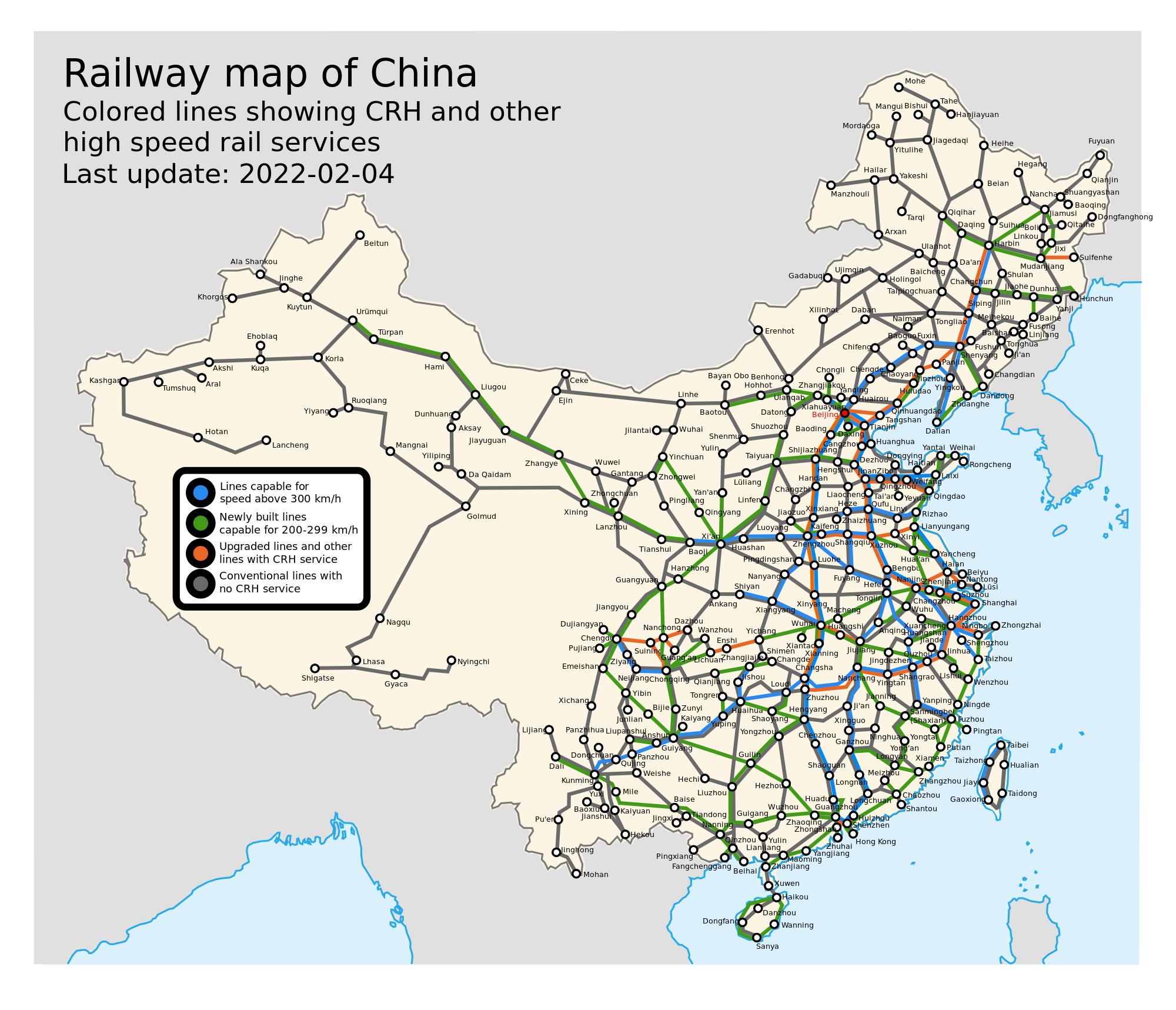
southwest China train lines, as of 2013,   see enlarged map at: http://www.flickr.com/photos/98531730@N02/9513433053/sizes/l/in/set-72157634969538546/   from http://upload.wikimedia.org/wikipedia/commons/thumb/f/fc/Rail_map_of_China.svg/2000px-Rail_map_of_China.svg.png

current and planned high speed rail in China , see enlarged image at: http://www.flickr.com/photos/98531730@N02/9516300538/sizes/l/in/set-72157634969538546/, from

All aboard: High-speed rail network connecting China, March 2013,

http://www.kpmg.com/CN/en/IssuesAndInsights/ArticlesPublications/Newsletters/China-360/Documents/China-360-Issue7-201303-High-Speed-Rail-Network-v1.pdf

Train – Guiyang Train Station (贵阳火车站)
Guiyang’s train station is located near the heart of the city. As the station is SW China’s main hub, everyday there are about 100 trains that go to hundreds of cities in the area and all around China. (full list of Guiyang departures) Guiyang is a major stop that connects the east to Kunming (12 hours, about 130 yuan hard sleeper), the west to Guangzhou (30 hours, about 350 yuan hard sleeper) and the North to Chengdu (16 hours 170 yuan hard sleeper) and Chongqing (8 hours 100 yuan hard sleeper). There are no direct trains from Guiyang to Guilin but you can get to Hunan through Kaili. There is even a direct train from Guiyang to the island Hainan that transports you by boat (sleeper 300 yuan).

To buy a ticket one must be able to speak basic Chinese, come pre-prepaired with your written itinerary or use one of the ticket machines at the train station. You can buy a ticket at the train station starting 10 days prior to your departure. Throughout the city there are also small ticket booths where you can buy tickets for an extra 5 yuan. The most prominent one is located inside the Postal Savings bank across the street from Pizza Hut in Peng Shui Che.

Upon entering the city you can either take a public bus or a taxi. Across the street from the train station you will see many buses lined up. Bus 1 and 2 will take you to the center of the city. After the buses near the train station hotel there is a line for metered taxis. That being said taxis can be difficult to get, especially if you want a meter at night. Beware if you are foreign taxi drivers will try to overcharge you. A metered taxi in Guiyang starts at 8 yuan and goes up after you reach 2 km. If you can get a taxi to go to where you need to go for 10-15 yuan take it.
(from goguizhou.wikispaces.com/Transportation )

= = =

Railway

Guiyang is a railway hub in southwest China. The Guizhou–Guangxi Railway (built in 1959, modified 2009), the Sichuan–Guizhou Railway (completed 1965), the Guiyang-Kunming Railway (completed 1970), and the Hunan–Guizhou Railway (completed 1975) are intersecting in Guiyang Railway Station. This main southern railway station is being rebuilt in 2008.
There are four high-speed rail lines to and from Chengdu, Chongqing, Guangzhou, Kunming, and Changsha and that will commence operations within the next few years. The high speed railway lines will provide rapid freight service from two rail yards, and passenger service from a new high-speed railway station, called Guiyang North Railway Station, in the city’s Guanshanhu District.

(from Wikipedia, en.wikipedia.org/wiki/Guiyang )

Jinyang 金阳(northwest district of Guiyang) Bus Station

Now main bus station for Guiyang. In Jinyang area 45 minutes to the northwest of Guiyang city center.

from goguizhou.wikispaces.com/Transportation :
By Bus
Guiyang has one major long-distance bus station in Jinyang.
The long-distance bus stations are also the best location to get buses to Anshun (60-90 minutes), the gateway to Guizhou’s signature Huangguoshu Waterfall. Buses north to Zunyi (two hours) depart every 30 to 60 minutes.

Car
Geography is what makes Guizhou so great but it also makes it hard to access. That is why the highway infrastructure in Guizhou is constantly undergoing repairs and upgrades. There are expressways to Chongqing, Zunyi and Anshun, Kunming and Kaili but they aren’t what you imagine when someone tells you it is an expressway. It is possible (although expensive, so it may be better to take the bus or train) to hire a car and driver between Guiyang, Zunyi and other cities starting at 500 yuan ($80) a day.

Transportation – Getting Around
Taxi
Taxi’s in Guiyang start at 8 yuan for the first 2 km and increase by 2 yuan for every 1km after that. Taxis can be hard to find during rush hour especially on main roads, if you are having problems finding a taxi, try a smaller road. Also Guiyang has many black taxis. Most of the time these taxis work perfectly, but there have been a few cases of black taxi drivers either trying to rip-off foreigners or trying to commit even worse crimes, use them at your own risk.

Public Bus
Public buses in Guiyang are cheap and extensive, but with larges amounts of people using them and Guiyang’s infamous traffic, they can sometimes be a pain to use, especially if you cannot get a seat. Below is a list of all the bus routes. You may click on the number to see where the bus goes, for how long and what to do/see at each station.

= = =

Expressway

The city is located at the junction of four major segments of the national highway grid: the Gui-Huang, Gui-Zun, Gui-Bi, and Gui-Xin Expressways.
The Gui-Huang Expressway (G60) links Guiyang with the cities and tourist areas of central and western Guizhou including Anshun, Guanling, and the Huangguoshu Waterfall. The expressway continues west to Yunnan Province as the Gui-Kun Expressway and terminates at Yunnan’s capital city of Kunming.
G75 Lanzhou–Haikou Expressway runs north 180 km (110 mi) to Zunyi and is the most heavily travelled major highway in Guiyang. In Zunyi, the expressway becomes the Zunyi-Chongqing Expressway and runs a further 210 km (130 mi) north to Chongqing.
G76 Xiamen–Chengdu Expressway links Guiyang with the regional cities of Bijie and Dafang in northwest Guizhou province, southeastern Sichuan province, and the Sichuan cities of Luzhou, Neijiang, and Chengdu – Sichuan’s provincial capital. The Gui-Bi Expresway begins at an interchange with the Gui-Zun Expressway in the city’s Xiuwen County approximately 20 km (12 mi) north of the city center, before terminating at the city of Bijie. In the city of Dafang, approximately 40 km (25 mi) east of Bijie, the Gui-Bi Expressway connects with the new Sichuan-Guizhou Expressway, a modern highway providing access to Luzhou and central Sichuan.
The Gui-Xin Expressway begins at the junction of the Guiyang Outer Ring Road (G75-G60.01) and the Tang Ba Guan Road, approximately 5 km (3.1 mi) southeast of the city center. The Gui-Xin Expressway (G60-G75) runs east and southeast through the Guangxi Zhuang Autonomous Region (G76), passing through Guilin, before entering Guangdong, and terminating at Guangzhou.
Approximately 170 km (110 mi) east of Guiyang in the regional city of Kaili, the Hunan-Guizhou Expressway (G56-G60) links with the Gui-Xin Expressway providing high-speed vehicular access to and from Guiyang to the eastern Guizhou city of Tongren before continuing through Hunan to the major cities of Huaihua, Changde, and Changsha.
In 2009 Guiyang added a modern orbital expressway to its highway network. The Guiyang Outer Ring Road (Guiyang Orbital Highway) opened in December 2009 and is a six- to eight-lane divided high-speed expressway that provides efficient links to and from large employment centers in the Jinyang New District, Baiyun District, Huaxi District, the Guiyang Longdongbao International Airport, the major multi-lane national highways, and the city’s main roadways, allowing vehicular traffic to circumnavigate the heavy traffic of the city’s inner city areas.
China National Highway 210

(from Wikipedia, en.wikipedia.org/wiki/Guiyang )

Gaotie high speed trains will come to future Guiyang North Station in Jinyang — hopefully in several years

see enlarged image at: http://www.flickr.com/photos/98531730@N02/9516188476/sizes/l/in/set-72157634969538546/

Guizhou to Chengdu:
成贵高铁起于成都南,途经乐山、犍为县、宜宾市、长宁县、兴文县而后进入云南境内过威信县、镇雄县最后再进入贵州省毕节市、大方县、黔西县东至贵阳市 ,形成四川至珠三角等沿海地区的快速大通道。成贵高铁全长约全长632.6公里,总投资780亿元,为客运双线高速铁路,行车速度250公里/小时, 列车类型为和谐号动车组。工期4年半,建成后成都至贵阳从目前17小时减少为2小时左右。素有“世界第一条山区高速铁路”之称。
(from Baidu, baike.baidu.com/view/4766536.htm?fromId=2693963&redir… )

Guizhou to Guangzhou:
贵广高铁是中国一条建设中的连接贵州省贵阳市与广东省广州市的客运专线,线路自贵州贵阳北站起,经广西桂林、贺州、广东肇庆、佛山至广州的广州南站。 设计线路长度861.7公里,设计标准是双线电气化客运专线,基础设施设计速度(土建设计速度)为300公里/小时的无砟铁路(其中,枢纽地段贵阳- 龙里和肇庆-广州为200~250km/h的有砟铁路),建成后贵阳至广州的列车运行时间将缩至4小时以内。2008年10月13日开工建设,工程投 资858亿元,预计6年内完工。全长857公里,广东境内207.5公里、广西境内348.5公里、贵州境内301公里。
(from Baidu, baike.baidu.com/view/1961893.htm )

= = =

Guiyang – Guangzhou high speed rail due to open Dec 24, 2014. [heard from Jack Porter’s travel agent, Nov 4, 2014]

High-speed ralway network in South China

Guiyang-Guangzhou high speed rail to open this December

2014-09-16 05:54:30 [http://english.cqnews.net/html/2014-09/16/content_31993802.htm]

The construction of the Guiyang-Guangzhou high speed rail has come to an end and its debugging is being carried out to make sure the line is put into operation by the end of the year, the Guiyang-Guangzhou high speed rail scheduling conference was told.

It is expected that the standard speed of the Guiyang-Guangzhou line will be 250 km/h. With a total length of 857 kilometers, the high speed rail will start from north Guiyang, stopping at Longli, Duyun, Danzhai, Rongjiang, Congjiang, Guilin, Gongcheng, Hezhou, Zhaoqing, Sanshui and Foshan, to arrive at its terminal Guangzhou.

There are 21 stops in total, and 8 stops among them are inside Guizhou province.

After completion, the duration from Guiyang to Guangzhou will be reduced to only 4 hours, from as long as 20 hours before.

Tunnels will carry more than 80 percent of the Guiyang-Guangzhou high speed railway. And for convenience, a 3G and 4G network will cover most of the tunnels.

Source: China Daily

= = =

Guiyang–Guangzhou High-Speed Railway – Wikipedia, the free encyclopedia

image
Guiyang–Guangzhou High-Speed Railway – Wikipedia, the…

Guiyang-Guangzhou High Speed Railway is a major trunk route selected in the 11th Five Year Plan by the Chinese government. It will allow a fast link bet…
Preview by Yahoo

ChinaRailwayHighspeed.svg

Guiyang-Guangzhou High Speed Railway is a major trunk route selected in the 11th Five Year Plan by the Chinese government. It will allow a fast link between the South-West Chinese provinces of Sichuan,ChongqingGuizhou and Guangxi to the economic power houses of China in Guangdong and Hong Kong. It will allow for a massive reduction travel time between Guiyang and Guangzhou from 22 to 4 hours.

The 857 km route of this railway is more direct than current routes. This is due to the exceptionally difficult and mountainous terrain, making this high-speed project very expensive to construct. Project cost is estimated at 85.8 billion RMB (USD$12.6 billion).[1] This means 209 tunnels are required over the length of this route, some being in excess of 14 km in length.[2] It will pass through the major tourist destinations of Guilin and Yangshuo in Guangxi province with its unique karst landscape.

Construction commenced in 2008 and is expected to take 6 years to complete.

= = =


= = =

China Said to Plan $16.3 Billion Fund for ‘New Silk Road’

By Bloomberg News  Nov 4, 2014  [http://www.bloomberg.com/news/2014-11-04/china-said-to-plan-16-3-billion-fund-to-revive-silk-road.html]

China plans a $16.3 billion fund to finance construction of infrastructure linking its markets to three continents as President Xi Jinping pushes forward with his plans to revive the centuries-old Silk Road trading route.

The fund, overseen by Chinese policy banks, will be used to build and expand railways, roads and pipelines in Chinese provinces that are part of the strategy to facilitate trade over land and shipping routes, according to government officials who participated in drafting the plan.

More policies will be rolled out soon to encourage Chinese lenders to finance infrastructure in countries along the route connecting China to Europe, said the officials. They asked not to be identified as they weren’t authorized to speak publicly about the plans. Chinese companies will also be urged to invest in the countries and bid for contracts, the officials said.

The New Silk Road plan, comprising a land-based belt and a maritime route, has been referred to as a Chinese national strategy after Xi first proposed the idea in Kazakhstan a year ago. It envisions an economic cooperation bloc through to the Mediterranean that revives the old Silk Road, where trade helped developed civilizations along the route.

“Previously, China focused on attracting foreign investment, but now the shift is being made — China’s more and more encouraging its capital to go abroad,” said Feng Yujun, senior researcher at theChina Institutes of Contemporary International Relations in Beijing.

APEC Summit

Xi’s overseas push comes as he tries to shape China as a great power, restoring its maritime dominance in the Asia-Pacific and extending its political and economic influence across the region, where it has been asserting itself in territorial spats. Next week, Xi will reinforce the image as he hosts U.S. President Barack Obamaand other world leaders at the Asia Pacific Economic Cooperation summit in Beijing.

The State Council Information Office didn’t immediately respond to faxed questions seeking comment.

The fund will finance domestic infrastructure construction and will be overseen by Chinese policy banks such as China Development Bank, the officials said. Financing will be limited to regions in the plan: Central Asia, the Middle East, South Asia, Southeast Asia and parts of Europe, they said.

The plan signals “a shift in China’s strategic thought,” said Zhang Yunling, director of the Institute of Asia-Pacific Studies at theChinese Academy of Social Sciences. The past three decades of China’s development have been focused on “absorbing foreign investment” and the next step will be about the outflow of Chinese development to its neighbors, he said.

Provinces Competing

Xi raised the “New Silk Road Economic Belt” idea at his speech in the Kazakhstan capital Astana on September 7, 2013. One month later, when addressing the Indonesian parliament in Jakarta, he pitched “the 21st Century Maritime Silk Road.”

The proposal has inspired competition between officials from Chinese provinces, especially the poorer western regions, seeking to tap the funding. Vice premier Wang Yang said in September in Urumqi, the capital of the western Xinjiang region, that it had a “prominent role to play” in the economic belt and the central government “supports Xinjiang to seize the historical opportunity” to become the hub of the belt.

The southern province of Guangdong, a manufacturing center that helped power China’s economic rise over the past three decades, in early November hosted the inaugural international expo for the maritime Silk Road, with 42 countries participating.

India, Afghanistan

“One of the most important considerations in the strategy is its attempt to reduce the imbalance between the eastern coastal areas and the western inland areas,” Feng said.

Xi, who has said his home province Shaanxi was the starting point for the old Silk Road, has recently ramped up efforts to sell his strategy overseas. During state visits in September he secured verbal commitments from three countries along the routes — Tajikistan, the Maldives and Sri Lanka. India has also shown interest and Afghanistan’s new president Ashraf Ghani Ahmadzai said at his summit with Xi in last week that his country was keen to be involved, according to the official Xinhua News Agency.

According to a map published on the website of the official Xinhua News Agency in May, the land-based Silk Road starts from the ancient capital city of Xi’an, stretching west through Lanzhou and Urumqi before running southwest across Central Asia, the Middle East and Europe.

The sea-based Maritime Silk Road goes through Guangdong and the southernmost Chinese province of Hainan, an island, en route to the Malacca Strait and Indian Ocean. It traverses the Horn ofAfrica before entering the Red Sea and Mediterranean. The two roads are supposed to meet in Venice.

Once complete, the Silk Roads will bring “new opportunities and a new future to China and every country along the road that it is seeking to develop,” according to the Xinhua article.

old photos of Guiyang

men’s fashions, 1940s Guiyang 贵阳人的穿着

this and many photos below found at: http://shanshuiqiancheng.soufun.com/bbs/3314011348~-1/53710480_53710480.htm,  set of old photos of Guiyang uploaded at:  http://www.flickr.com/photos/98531730@N02/sets/72157634952466595/with/9485648640


Guiyang No. 3 Middle School 贵阳三种, 1949 photo, then later bldg on Yangming Rd  阳明路上的老三中, and the current building

在30年代初期,贵阳还几乎没有什么汽车,城中心的大十字到处都是人力车。

former Water Fountain (now paved over) 喷水池, Guiyang

【黔城往事】“喷水池”最后一瞥 作者:黔山毛豆 日期:2010-02-25
现在就是历史。贵阳市最繁华的“喷水池”原名“铜像台”,因铸造有周西成一尊铜像而得名。1933年开始筹建,历时两年半,于1935年夏建成。19 52年拆除铜像,改建为街心花园,中有喷泉,称为喷水池。此后,喷水池经过数度改造,终成为照片中的模样。2010年2月18日凌晨,喷水池拆除工程 动工,将拆除现有环岛和雕塑,改为十字交叉口;在交叉口设置四个交通导流岛,导流岛内设喷泉小品和绿化,兼顾城市景观和延续“喷水池”历史传统。拆除 以后,那个被贵阳人称为“巨大背篼”的城市雕塑将如何处置?择地放置?当废金属卖掉?或是融掉?

(from www.qtwm.com/default.asp?tag=%E9%BB%94%E5%9F%8E%E5%BE%80%… )

1930s Guiyang postal delivery   30年代贵阳的一个邮政局,大量的邮件正等待运出

Guizhou University, early phtoto 1942年成立的国立贵州大学

http://img1.soufun.com/bbs/2011_12/06/18/guiyang/1323166809645_000.jpg


Jiaxiulou, in Qing era photo 甲秀楼,

from www.gzbs.cn/photo/old/2009/0422/29979_3.html

from www.gzbs.cn/photo/old/2009/0422/29979_4.html


photo

What happened to Guiyang’s memorial arches to women’s faithfulness on Youzha Road? Answer: Houses went up around them !

后来的油榨街的贞洁牌坊,贵阳

油榨街原来是这样的
这条到排满了贞洁牌坊的道路,就是后来的油榨街,表彰的是烈女节妇,记录的却是女人的命运,现在早已荡然无存……
一个担着货物进城的农民走在这样一条石头铺就的道路上,也算当时的一条大道了吧?

– – –

【黔城往事】最后的牌坊:高张氏节孝坊 作者:黔山毛豆 日期:2009-02-05
贵阳老牌坊照片中的这些老贵阳牌坊位于今天的油榨街附近,是十九世纪下半叶到过贵阳的法国人拍摄的,这些牌坊沿道路整齐排列非常壮观。二十世纪中叶, 老贵阳城及其附近先后有牌坊多达数百个,“在贵阳城内走不了几步就有一座牌坊”。但由于自然风化、年久失修、战争、城镇扩张、以及1949年以后的历 史事件导致的严重破坏,在2002年出版的《贵阳掌故》一书记载说,老贵阳这数百座牌坊均已不存。

但在2003年9月,贵阳市南岳巷10号一片低矮、零乱的民宅中有人发现这座基本保存完好的,始建于清道光二十一年的牌坊——高张氏节孝坊。于是,在 幸免的老牌坊再被发现之前,这座牌坊就是贵阳城区唯一幸存的古牌坊,也是贵阳至今仅存的四座古牌坊之一。其余三座古牌坊全部位于青岩古镇,分别是建于 道光十九年的“赵彩章百岁坊”、建于道光二十三年的“赵理伦百岁坊”、建于同治八年的“周王氏、媳刘氏节孝坊”。

在陈正军的《贵阳牌坊话沧桑》文中,对这座“高张氏节孝坊”有着详细的介绍:“高张氏节孝坊”建于道光二十一(1841)年,竣工完成于道光二十二( 1842)年,高8米宽9米,从牌坊上文字可辨认出,牌坊呈南北走向,正面朝北,形制为三间四柱四阿顶式石结构,中间石坊上立斗型斗拱,中斗拱有“圣 旨”,其余斗拱为神话传说浮雕图案;下部边柱有抱鼓石,中额石坊左右雕饰龙戏珠图(现已有裂痕,易毁落)。该坊之顶有圣旨,坊四柱均有石刻对联,其中 中柱两侧联是:“茶类遭逢夫叹螟蛉子叹螟蛉半生冰雪留孤影;□贞偏附娣伤鸾凤姒伤鸾凤万古云霄矢此心”,正面次楼额匾刻写:“道光二十二年十月二十三 日□□两浙运副贵筑县学附生大弟廉男培昀奉旨谨建”,小额匾刻:“处士张成瑶之……”背面次楼匾书:“道光二十一年……,匾下刻:“广东广州府知府高 廷遥”。它已是贵阳市区保留的唯一古牌坊了。

在儒风的《贵阳古今牌坊(续)》中,关于这座“高张氏节孝坊”有如下文字:据牌坊所在的民居户主许弟兴老人讲,他家是在上世纪(黔山毛豆注:二十世纪 )三十年代末住在那里,他说那里原有六个排列的牌坊,“高张氏节孝坊”排在最后一个,“文革”时曾有人想把它弄掉,因为其一民居狭窄,不便拖拉,其二 ,该牌坊位置离地面较高,也不易施工,随着时间推移,渐渐被人们忘记了。

我的“宝马”车,走街窜巷得靠它。

隐藏在破旧民居中的“高张氏节孝坊”,不太好找。

住在牌坊“里”的人家。

藏在民居里,缺乏保护的,贵阳市区唯一的古牌坊啊。

贵阳市仅存的,唯一的古牌坊——高张氏节孝坊。与其他历史、文化厚重的城市比起来,贵阳本来就没有什么可说道的,现在好不容易阴差阳错意外的有那么一 点点“文物古迹”,但却完全没有得到应有的保护,再不保护就不用保护了,没了还保护什么?

Tags: 黔城往事 贵阳 牌坊 高张氏节孝坊

from http://www.qtwm.com/default.asp?tag=%E9%BB%94%E5%9F%8E%E5%BE%80%E4%BA%8B&page=3 ,  http://www.gzbs.cn/photo/old/2009/0422/29979_7.html , http://www.flickr.com/photos/98531730@N02/9483475877/sizes/l/in/set-72157634952466595/ ,

WW2 British army officers passed thru Guiyang in 1942 escaping Japanese takeover of Hong Kong, going to Burma Road

Officers enjoying a day out in Guiyang, Jan 26 1942

photos from : www.hongkongescape.org/Legge.htm,  uploaded at: http://www.flickr.com/photos/98531730@N02/9512944499/

Some of the Officers enjoying a day out in Guiyang with their female hosts who were from Shanghai

Sub-Lt Gee, Sub-Lt Brewer, Sub-Lt Legge, Lt parsons, Lt Kennedy. . Sub-Lt David Legge in the centre had lived in Shanghai and spoke the language, and so was the interpreter. Sophie Lim, and the Chen sisters.

On the right is Lt Alexander Kennedy of MTB 09, the author of the self published book “Hong Kong Full Circle”

www.hongkongescape.org/Escape_09-9.htm

Guiyang -Huachi Park, Jan-1942 ‘Escape from Hong Kong’

= = =
23rd January 1942 (Fri)

Officers enjoying a social outing during their stay in Kweiyang 26th Jan 42 ;
Dr Lim’s daughter Effie is wearing a kilt and spoke her native tongue with a Glasgow accent.
Click here to enlarge ;

Photo from Alex Kennedy’s collection © L/S Les Barker: “Dawn start, on the way to Kwei-Ang. The road is very treacherous, covered with a layer of mud and all the time we are climbing. Raining very fine rain so it doesn’t give the road a chance to dry up. Plenty of traffic on the roads, and we also see Shetland ponies with bells on their heads. Sometimes these ponies were 40 or 50 in a line, led by one or two men.
We were skidding a lot this morning on this murderous road. 1015 – And our lorry failed to negotiate an ‘S’ bend and, before we knew what was happening, we toppled over, taking a complete turn and a half. Luckily we only had four injured, but if we had gone over once more there was a drop of 100 feet and we should have all been killed.
After, the lorry was hauled back to the right way up and, after treating the wounded and getting them away in another lorry, we piled back into the same lorry and proceeded again to Kweiyang, very much shaken by our experience and leaving the road littered with eggs and oranges.
Driving more carefully after that, we finally arrived at Kweiyang and were met by a party of Chinese Red Cross who had everything prepared, clothing, cigarettes, hot baths, etc. Very much appreciated by all hands.” [24]

MTB 07’s Fair Log: “On again at 7 am. Truck with Lt Collingwood overturned some 90km from Kweiyang. Three or four casualties—not serious, one with fractured collarbone. Last truck left Thulsaban? At 6.45 am. Maclongping At noon; sick man put in ambulance. Left at 2pm, arrived Kweiyang 7 pm.” [5]

L/S Les Barker “The road was treacherous and inches deep in mud. Just before the end of the journey, the lorry in which I and 13 companions were travelling failed to negotiate an “S” bend and turned a double somersault.” [24]

Lt Collingwood RN: “One truck skidded and turned and five men were hurt but it was put back on the road and we continued.” [8]

Sub-Lt Legge HKRNVR: “My truck, which was second in the convoy had about fifteen men inside with me in the back between two fifty gallon gasoline drums looking out backwards. My Captain (Collingwood) was in front with the driver. Going round a steep corner, we started to skid. On the off side was a drop of several hundred feet. Luckily we hit a large stone at the outside of the road, turned around across the road and turned over.
I didn’t realise what was happening until I found myself sitting in the mud in the road with the truck on top of me. The truck had only iron hoops and a canvas cover and we would all have been squashed had it not been for the fact that one of the gasoline drums fell on end with the end of the truck sitting on top of it.
We were in a pretty pickle, 80 kilometers from the nearest telephone, sitting in the rain and mud and no way of getting immediate help. Then as I was attending to one of the men who had a deep cut above the eye, he pointed out that blood was pouring down my face.
There were two other men fairly badly hurt, but except for extensive abrasions we couldn’t find out what was the matter. Then luckily the next truck came along. We transferred the wounded into that and with myself in the front set off 80 km. to Kweiyang where there was the nearest hospital. It was a terrible ride as not only was the road very bad with all the rain that was coming down, but the wounded men were in rather bad shape.
We had morphine with us but didn’t like to give it in case they had to have an immediate operation on arrival and couldn’t be given any more anesthetics.” [18]

L/S Les Barker: “Luckily only four were injured – but if the vehicle turned over once more it would have fallen 100 feet and the whole party would certainly have been killed. The Chinese driver wept. From then on he drove more carefully.” [24]

A/B Lenny Rann: “The road was full of hairpin bends and the truck in which I was riding capsized and several of the occupants were injured.” [66]

Dr Lim & Lt C J Collingwood R. N. with others in Guiyang
Photo from the Ashby collection ©
They eventually arrive at the Chinese International Red Cross headquarters in Guiyang, four thousand feet up in the mountains, which is the medical centre for the Chinese Army. Dr Robert Lim known by all as Bobby, a physiologist met them on arrival, he was educated at the “George Watson College” in Edinburgh and had married a Scots woman. He had served on the Western Front with British forces in the Great War of 1914-18. He set up the Chinese Red Cross after the Japanese invasion of Manchuria in 1937. He was also a former golfing partner of Admiral Chan Chak. Lt Ron Ashby arrived later by ambulance. There they attended to the party’s injuries to the best of their abilities and Lt-Cmdr Gandy procured funds which enabled the party to do some essential shopping. They were billeted within the hospital complex.

PO Buddy Hide: “On the way a lorry overturned and three men suffered with broken bones. Guiyang is the medical centre for the Chinese Army. There they attended to our injuries to the best of their abilities and supplied us with Red Cross ambulances to take us to Lashio, in Burma.” [21]

Sub-Lt Legge HKRNVR: “The Chinese Red Cross has a wonderful hospital at Kweiyang, all mat sheds but very well run. They were prepared for us as we had arranged in advance to stay with them for a day or two. We found that two chaps had broken shoulder blades among other minor things. I had to have seven stitches put in the top of my head, which was not so pleasant as it was about five hours after the accident.” [18]

L/S Les Barker: “At Kuel-Ang, the Chinese Red Cross had everything prepared – food, beds, hot baths, clothing and cigarettes.” [24]

Lt Kennedy RNVR: “Accommodation for the whole party had been prepared in the hospital camp lying in a fold of the hills called Tuyunkwan, where Dr Lim took us himself and showed us around the huts. The meaning of Tuyunkwan we were told was cloud-earth-pass.” [9]

Eddie Brazel (HKRNVR): “Here we stayed at the headquarters of the Chinese International Red Cross, who had a wonderful place. During our stay of three days in Kweiyang we had a marvelous time, being entertained by Governor Wu amongst others, in addition we played the training school at football.” [49]

John Grindlay

Photo from Prof Al Lathrop, University of Minnisota collection ©There was also a visiting American Army surgeon with the American Military Mission to China (AMMISCA), 1st-Lt Dr. John Grindlay, of the U.S. Army Reserve.

US Army 1st-Lt Dr Grindlay: “About 2 p.m. great excitement — the 40 refugee sailors & Officers who escaped Xmas day from Hong Kong arrived — 32 in the first bunch. Rain & mud on road & one truck had skidded off & turned on side — resulting in several injuries — lacerations. Nearly all bearded.
The overturned truck came on a little later than first 2 & it was evening before Gandy & several officers & a sick man [Ashby] with] suspected typhoid came on. Altogether 16 officers, rest “ratings” Brewer, Legge, Collingwood, Kennedy, Gee, & Parsons were younger officers.
First men all slipped & skidded through mud to new barracks. These cleaned up & fires in gas drum stoves going. I am sure the arrangements pleased the men, also sure they didn’t know at what effort that had been arranged, & the cost of things procured — as the entire Chungking gin supply of Bobby’s (Dr Lim) they drank — Dr T F Chang — They drank 16 catties (1 1/3 pints) of mine.
Gandy, a retired Lt-Cmdr on active duty, very thoughtless and demanding type & not liked by the men.”
He had a long talk with Parsons who stated “Battle of Hong Kong a huge Brit disaster.” [37]

The party were given the freedom of the City after a speech by General Wu at the City hall and each was given a card showing the primitive life of the Chinese tribes, sealed with the Governor’s private seal and signature.

A/B Lenny Rann: “On January 23rd we arrived at the Chinese International Red Cross premises at Guiyang, where we were again well looked after and were given the freedom of the city by the governor.” [66]

At 4 p.m. they had a cinema show put on by the Red Cross followed by a few sketches put on by the navy party which brought hoots of laughter. Dr Lim offered the use of his Red Cross Ambulances to transport the party to Kunming, the Chinese end of the Burma Road as they were driving there empty to pick up medical supplies.

Gandy giving a speech in Goiyang accompanied by Pittendrigh & Brewer ©

Lt-Cmdr Gandy RN accompanied by Lieut Pintendrigh RNR, and Sub-Lieut Brewer HKRNVR giving a speech in Guiyang.

24th January 1942 (Sat)

MTB 07’s Fair Log: “Visit to Governor in the morning. Conducted tour of centre in the afternoon, followed by a tea, & movies after dinner.” [5]

Lieutenant Commander Gandy R. N. (Rtrd) “Each member was given a memento of the visit.” [15]

Lt Collingwood RN: “Luckily my sub-lieutenant spoke Chinese so we were normally in the van for the feeding and sleeping arrangements.” [8]

Sub-Lt Legge HKRNVR: “We all bunked in a large dormitory, which had big stoves in the center, heaven to us after the places we had been sleeping. Also we had our first decent liquor. They were very good to us and we were looked after like kings. There were one or two pretty ex-Shanghai girls there, with whom I spent most of my time the next few days, rather, I think, to the jealousy of other less fortunate officers.” [18]

Major Goring had now recovered from his malaria attack at Kukong and proceeded by train to Kweilin and from there by air to Chungking. Lt-Col Harry Owen-Hughes and Dr Moore took him to the station.

Maj Goring BHQ: “After tea I said goodbye to the gallant little Admiral, whom I was very sorry to leave. I had liked him well in Hong Kong, and grown to love him during our journey, for he had shown himself not only a man of infinite pluck and resource, but also extremely thoughtful for others.” [17]

25th January 1942 (Sun)

Visit to Local Park at Huachi followed by soccer match in the afternoon, losing 6-1 against the Red Cross training school. Also in the afternoon a visit to the British run “Friends Ambulance Brigade” that was passing through Guiyang on their way into China. Kennedy soon spotted a A day out in Huachi park
Photo from the Hide family collection ©fellow Scot, Andy Braid, who it turned out had his pipes with him. As it was Burns night they took turns on the pipes.

MTB 07’s Fair Log: “Visit to park (Huachi) in the morning. Soccer match in afternoon, we lost 6-1. Dinner in the evening given by Governor.” [5]

Lt Kennedy RNVR: “I met a Scotsman in the wilds at the back of beyond. He used to go out into a rice field and play his bagpipes, to the great amazement of the local children and hordes of mongrel dogs which joined in the chorus.
The hut we were in was a small one and very soon indignant protests from the other members of the party forced us outside. It was getting dark as we played in turn along the edge of a paddy-field, some of the old marches from school-days, Barren Rocks, Pibroch of Donald Dhu, and the poignant notes of Loch Duich. We were totally absorbed and only when we stopped realised that a large crowd of children were watching us with aw from a safe distance with all the dogs in the neighborhood howling in the background.” [9]

In the evening they were all invited to a farewell dinner laid on by the Governor, who unfortunately was unable to attend. The evening passed with Dr Lim reciting “Ode to a Haggis” much to everyone’s surprise.[9] A very enjoyable evening was had by all with much local rice wine being consumed to the many shouts of “Kan-Pi.”

Lt Kennedy RNVR: “Many decided to leave the party before the national anthems were sung, but one resolute member, formerly the Coxswain of MTB 10 (CPO Thums) who had stayed too long was seen to stiffen like a ramrod during ‘The King,’ although he was lying flat on his face on the floor. The instant the singing stopped he shot to his feet as if revived and made for the door.” [9]

26th January 1942 (Mon)

Brucy the ships dog

Photo from the Collingwood family collection © Dr Lim’s daughter Effie who “wore the kilt and spoke her native tongue with a Glasgow accent” [9] Effie accepted Bruce the ships dog as a pet.
Luckily for most it was a late start for Kunming, leaving at noon, with Kelly & Deakin in hospital recovering from the lorry crash.
The convoy of five Red Cross ambulances were boarded. Now with Ashby fit enough to travel they made their way down the hill towards the city of Guiyang, picking up the main Chungking to Kunming highway, The Burma Road. The road across the plateau was extremely bumpy passing through many fortified village wall-gates, with the ever present choking dust in the open ended trucks.

MTB 07’s Fair Log: “Left for Kunming about noon. Reached ANHSUN late afternoon.” [5]

Eddie Brazel (HKRNVR): “We left Kweiyang on the 26th for Kunming, via Anshan, Annan, Penghu, Kut Sing, and arrived in Kunming on the 29th.” [49]

The drivers were much better than the party had experienced in the past, stopping hourly to keep the convoy together and refreshments.

(from www.hongkongescape.org/Legge.htm )

Also:

American soldier in Guiyang in the 1940s 二战时代美国士兵在贵阳

贵阳第二个比较大的发展时期,大概是抗战时期了。当时,贵州成了大后方,全国各地有大量的人涌入了贵阳,使这个小城市的人口迅速增加到了40多万,于 是,到1941年,贵阳开始正式设市。城市建设也有了发展。在当时大十字的岗亭上,不仅有西门子的大钟显示这个城市的“现代”,而且还有值勤中国** 和美国士兵。 from http://shanshuiqiancheng.soufun.com/bbs/3314011348~-1/53710480_53710480.htm

Catholic churches, Guiyang: ‘North’ Church, near Youyi Rd 贵阳北天主教堂,近友谊路; South Church Xinhua Rd & Xinglong Rd 贵阳南天主堂, 位于贵阳新华路与兴隆街交汇处


photo

Guiyang ‘North’ Catholic Church, near Youyi Rd 贵阳北天主教堂

Biggest in Guizhou province, built in 1875 in a mixture of Western and Chinese styles.  Masses on Sunday at 9:00 am and 7:00 pm. There is an active seminary training Chinese priests at the site.  Map:

interior

front detail, incl. rose window, date of consturction  创建时间和玫瑰花窗

before restoration, from www.chiyou.name/page/new/2007/ywdls/

See many Guiyang historical photos, including this church, described in a Chinese article at: http://shanshuiqiancheng.soufun.com/bbs/3314011348~-1/53710480_53710480.htm

十九世纪的贵阳天主教堂。清乾隆三十九年(1774年)天主教传入贵阳。道光三十年(1850年)天主教贵州教区第一任主教白斯德望修建了贵阳第一所 正式天主教堂。同治十三年贵州主教李万美将原教堂拆除重建,光绪元年因火灾使即将完成的教堂付之一炬,后再行重建,于次年完工,即今上北堂之大教堂。 目前,贵阳北天主教堂仍是全省天主教的中心和最大的教堂。

images from : www.chiyou.name/page/lzp/btzt.htm , from www.17u.com/blog/article/1519083.html ,  uploaded at http://www.flickr.com/photos/98531730@N02/9480998747/in/set-72157634952466595 , http://www.flickr.com/photos/98531730@N02/9483733368/in/set-72157634952466595/

Guiyang’s “South” Catholic Church 贵阳南天主堂, 位于贵阳新华路与兴隆街交汇处

Article in Chinese with photos of this and still other Catholic churches and related buildings in various stages of repair, at: www.xiangtu.org/archives/286.html , photo and aricle in Chinese uploaded at: http://www.flickr.com/photos/98531730@N02/9481304907/in/set-72157634952466595/

Zimmer Foundation for China, for Tongren city, Guizhou prov.


from www.zimmerfoundation.org/about/index.php

The Zimmer Foundation for China was established to implement holistic programs to improve the economic and spiritual conditions in rural Guizhou. The Zimmer Foundation is a US 501(c)(3) tax exempt organization established in memory of Rev. & Mrs. Gerald R. Zimmer who served in China 1936-1948.
Rev. & Mrs. Gerald R. Zimmer were Educators who, in the middle 1930s decided they wanted to be missionaries and went to China to preach and teach. They went to a very remote area in the interior, to a small town of Tongren. There they lived with the people, learned their language and customs and worked to improve their situation.

They saw a need for teachers and help to found the Tongren Teachers College, which has since grown to be a full fledged university; Tongren University. The same desire Rev. & Mrs. Zimmer had to support needy students with scholarships is being carried on today with the generosity of people like you.

= = =

The Zimmer Foundation initiated a scholarship program in 2004 that supports the major cost of education for students annually for the second, third and final years at Tongren University. Now, over twenty students have been provided scholarships. It was our vision that at least two students will be added each year over a ten year program. Many donors have allowed us to exceed our visions of the scholarship program. The selection of the students is based upon their academic achievements and financial needs. The student’s family is identified with an income at or less than the poverty level established by the Tongren prefecture officials.
In villages of rural China, many students are the first of their family to complete college. Zimmer Foundation has arranged to financially support specific students with financial needs. The eligibility for receipt of such scholarships is first year college students with academic excellence who come from very poor families. Often these are children of farmers whose annual income is less than $264 USD. The families earn below the declared poverty level defined by each county.

= = =
Peace Corps China blog : My Life as a Complex Adaptive System

The Zimmer Foundation

2010 November 8, Posted by sky

This a short post tonight because it is so late, but I have a great story to tell. Since I arrived in Tongren, I have heard about a man affectionately called “uncle Stan.” His parents were missionaries in China and helped set up a hospital as well as the first church in Tongren. Several years ago, uncle Stan set up a foundation called the Zimmer Foundation. Its mission is to improve the quality of life in rural China, specifically by investing in education. The foundation sponsors a scholarship fund that relieves the financial burden that many of the students, who come from remote farming villages, face at Tongren University.

I had the pleasure of meeting uncle Stan today and I must say that he is quite an amazing man. I found out that he was born in Tongren and lived here for 5 years before moving to America. He had a long, illustrious career with IBM and since he retired has dedicated his life to helping people in his “hometown”.

His story and what he is doing is extremely inspirational and I wanted to include the link to his foundation’s website for you to have a look. Hooray for good people!  zimmerfoundation.org/index.php

(taken from Sky Lantz-Wagner’s blog, skylantzwagner.blog.com/2010/11/08/the-zimmer-foundation/ )

= = =
Measurable holistic services provided to needy students
1. Over 30 University Scholarships in rural China
a. Goal of minimun two each year
b. Meet total tutition and board for three years
c. Regular visits; banquets, outtings
2. Encouragement to local church
a. Regular visits and updates
b. Provision of Bibles and study materials
c. Provision of furnishing and church needs
3. Outreach to Local orphange
a. Encourgment to orphans
b. Visitation by scholarship students
c. Medical support
d. Collaboration with other NGOs

(from Stan Zimmer’s LinkedIn page,http://www.linkedin.com/profile/view?id=35057346&authType=NAME_SEARCH&authToken=uZSq&locale=en_US&srchid=1285106101376488877548&srchindex=3&srchtotal=5&trk=vsrp_people_res_photo&trkInfo=VSRPsearchId:1285106101376488877548,VSRPtargetId:35057346,VSRPcmpt:primary )


Chinese saying mentioning Guizhou: Qian Lv Ji Qiong (The Donkey Has Exhausted Its Tricks) – 黔驴技穷 : 黔 qian = Guizhou

from (from chinese.hm68.com/index.php/chinese-idioms/17-the-donkey-o… ; history.cultural-china.com/en/38History2824.html ;mychinaconnection.com/wp-content/uploads/2010/09/guizhou-… ; dictionary.kaide.net/char/9ed4/%E9%BB%94 ;www.nciku.com/search/zh/detail/%E9%BB%94/32354 ) ; uploaded at:  http://www.flickr.com/photos/98531730@N02/9517232920/in/photostream

karst geological formations: Those weird hills!

written about Guilin, but applies to Guizhou’s karst as well:   “Guilin’s most renowned feature is its dramatic karst terrain. Rising sharply at odd angles, limestone peaks look like giant teeth growing out of the green plain. Karst topography is characterized by many caverns and sinkholes that form by the dissolution of limestone or other carbonate rocks. Florida and Virginia’s Shenandoah Valley are good examples of where karst can be found in the United States. However, the topography looks completely different from that in China, thanks to conditions that exposed China’s karst and eroded its softer limestone faster. The specific conditions for forming the magnificent topography of Guilin “are fourfold,” according to Ray Beiersdorfer, a geologist at Youngstown State University in Ohio. “First, you need hard, compact carbonate rock. In Guilin, it’s Devonian limestone. Secondly, you need strong uplift, in this case provided by the collision of India with Asia to form the Himalaya. Third, you need a Monsoon climate of high moisture during the warmest season. Finally, the area must not have been scoured by glaciers, which this region wasn’t.”

Two types of karst landscapes predominate in Guilin: fenglin or peak forest (isolated towers) and fengcong or peak cluster (linked-base towers). The two types may have evolved sequentially from peak forest to peak cluster, or they may have evolved simultaneously. Beiersdorfer described this landscape, which he saw during a recent visit to China: “China in general and the Guilin area specifically boasts some of the most spectacular karst topography in the world.” ” (from www.geotimes.org/apr07/article.html?id=Travels0407.html )

Karst
Huge areas of China’s Southwest comprise visually spectacular landscapes featuring karst – weathered limestone formations. In China, limestone has been created from fossilized prehistoric sea floor sediments, brought to the surface by geological upheavals. The exposed alkaline limestone is then eroded by naturally-occurring acidic rain. Above ground, this results in anything from closely packed “stone forests,” poking a few meters skywards, to the huge conical hills covering half of Guizhou, and the tall, elegant pinnacles around Guilin. Underground, percolating water and subterranean rivers carve out long, interlinked caverns, hung with oddly shaped rock formations.
Karst formation
Southwest China’s thick and fractured pure limestone has led to a dramatically eroded landscape. The warm wet climate speeds up the weathering of limestone by acid rainwater and chemicals in rotting plants.
1. Surface streams lose water to cave systems developing in the limestone. Surface drainage is diverted down sink holes to below the water table.
Karst landscape
This cut-away artwork shows an idealized karst landscape, with all the features shown together. Karst topographies usually have a thick layer of cave-ridden limestone, and then, depending on the area’s geology and the age of the formation, a few of the features shown here.
Fenglin karst, which translates as peak-forest karst, is characterized by peaks that rise near vertically, like trees, 100 to 250 feet (30 to 80 m) above the surrounding flat floodplains. These dramatic tower-like karsts are found in and around the city of Guilin.
1. Surface streams lose water to cave systems developing in the limestone. Surface drainage is diverted down sink holes to below the water table.2. Peaks develop from the land left after erosion by the streams. The cave system gets larger as fast-moving subsurface streams bore through the limestone, and the water table drops.3. Much of the limestone has eroded past the caves down to a layer of shale. Limestone peaks remain, many fractured with small, waterless caves.
Caves that open out into large halls filled with stunning limestone formations are found throughout karst areas. Minerals deposited by losing streams and water drainage create the strange shapes.
Fengcong karst, or peak-cluster karst, differ from the straight-sided fenglin. Their peaks are more cone-shaped and one hill meets the next across a depression or doline. Superb fengcong landscape can be seen near the small town of Xingping.
The Li River cuts through an impressive variety of karst hills. Cruises start in Guilin with fenglin, which gradually give way to dense fengcong.
Stone forests, such as Shi Lin outside Kunming, are karst formations created by the retreating waters of ancient seas, and wind and rain erosion.
Fenglin karst, which translates as peak-forest karst, is characterized by peaks that rise near vertically, like trees, 100 to 250 feet (30 to 80 m) above the surrounding flat floodplains. These dramatic tower-like karsts are found in and around the city of Guilin.
Caves that open out into large halls filled with stunning limestone formations are found throughout karst areas. Minerals deposited by losing streams and water drainage create the strange shapes.
Fengcong karst, or peak-cluster karst, differ from the straight-sided fenglin. Their peaks are more cone-shaped and one hill meets the next across a depression or doline. Superb fengcong landscape can be seen near the small town of Xingping.
The Li River cuts through an impressive variety of karst hills. Cruises start in Guilin with fenglin, which gradually give way to dense fengcong.    from (http://www.chinaspree.com/china-travel-guide/china-guizhou-guangxi-tours.html )

images uploaded at: http://www.flickr.com/photos/98531730@N02/9455307987/in/set-72157634969798328 and http://www.flickr.com/photos/98531730@N02/9458080460/in/set-72157634969798328/

Jax Tea Party – video about living in Guiyang and teaching children English at a private school, Jack Porter, 2011

See Jack (John S. Portman,johnsporter@gmail.com) tell about his time in China.  Video viewable direct on Youku, title: “BNC_Jax_Tea_Party_121008 ” , v.youku.com/v_show/id_XNDYwMjI0NDg4.html

caption: This is a video about living in Guiyang and teaching children English at a private school.  This movie was made a couple years ago when I worked for the Tian Tian English School 田田英语.

Also viewable on this website: www.tourguizhou.net/category/jack/page/3/(embedded at the bottom of the page).